AI Agent Evaluation: How Enterprises Test and Validate Agents Before Production
Anil Nair is an enterprise AI strategist focused on AI governance, intelligent automation, agent orchestration and the architecture required to deploy AI systems safely across complex organizations.

AI agent evaluation is the practice of testing an agent against real business cases before it is allowed to act on live systems. It answers the question every production review asks: what evidence shows this agent does the right thing and what happens when it does not.
Most evaluation guidance is written for engineers selecting testing tools. The harder problem in an enterprise is deciding what counts as passing, who signs off on that decision and how the same tests get re-run each time the agent changes.
What Is AI Agent Evaluation?
AI agent evaluation is the structured measurement of an agent's behavior across complete tasks, covering the actions it takes, the tools it calls and the decisions it escalates. It goes further than model testing, which checks whether a single output is accurate.
The difference matters because an agent can produce a correct looking answer through a wrong sequence of steps, which is why Anthropic's engineering team treats agent evals as measuring the whole trajectory rather than the final response. A trade finance agent that approves a document check by skipping the sanctions lookup has produced the right answer for the wrong reason and that error will surface later on a case where it matters.
What to Measure in an AI Agent Evaluation

Useful AI agent evaluation metrics cover five dimensions, because an agent can pass on accuracy and still fail in production. Each dimension answers a different question from a different reviewer.
| Dimension | What it measures | Who cares most |
|---|---|---|
| Task outcome | Whether the completed task matches the expected result | Business owner |
| Trajectory and tool use | Whether the agent used the right steps, tools and data | Technical owner |
| Policy compliance | Whether it stayed inside permissions and business rules | Risk and compliance |
| Escalation quality | Whether it escalated the cases it should have | Operations |
| Cost and latency | Time and spend per completed task | Finance |
Escalation quality is the dimension most often skipped. An agent that never escalates looks efficient in a test and becomes a liability in production, so evaluation should measure both missed escalations and unnecessary ones.
How to Build an AI Agent Test Set
An agent test set is a collection of real business cases with known correct outcomes, used to measure the agent the same way each time. It should come from the organization's own history rather than from generic examples.
Start With Real Cases
Pull a sample of completed work from the process the agent will handle, including the cases people found difficult. Teams building agentic systems at Amazon report the same starting point, since generic benchmarks say little about one company's process. A health insurer building a prior authorization agent should include the approvals, the denials and the cases that went to clinical review.
Add Edge Cases and Out of Policy Requests
Edge cases are the situations that break assumptions: missing documents, conflicting records, unusual amounts and requests that policy does not permit. The agent should be measured on whether it stops and escalates, not on whether it produces an answer.
Include Adversarial Inputs
Adversarial inputs are attempts to make the agent act outside its permissions, including instructions hidden inside documents or messages it processes. An agent that reads supplier emails must be tested against an email that tells it to change bank details.
Keep the Set Growing
Every production rejection or correction becomes a new test case. This is where human in the loop AI feeds evaluation, since approver decisions are the record of what the agent got wrong.
How to Test an AI Agent Before Production
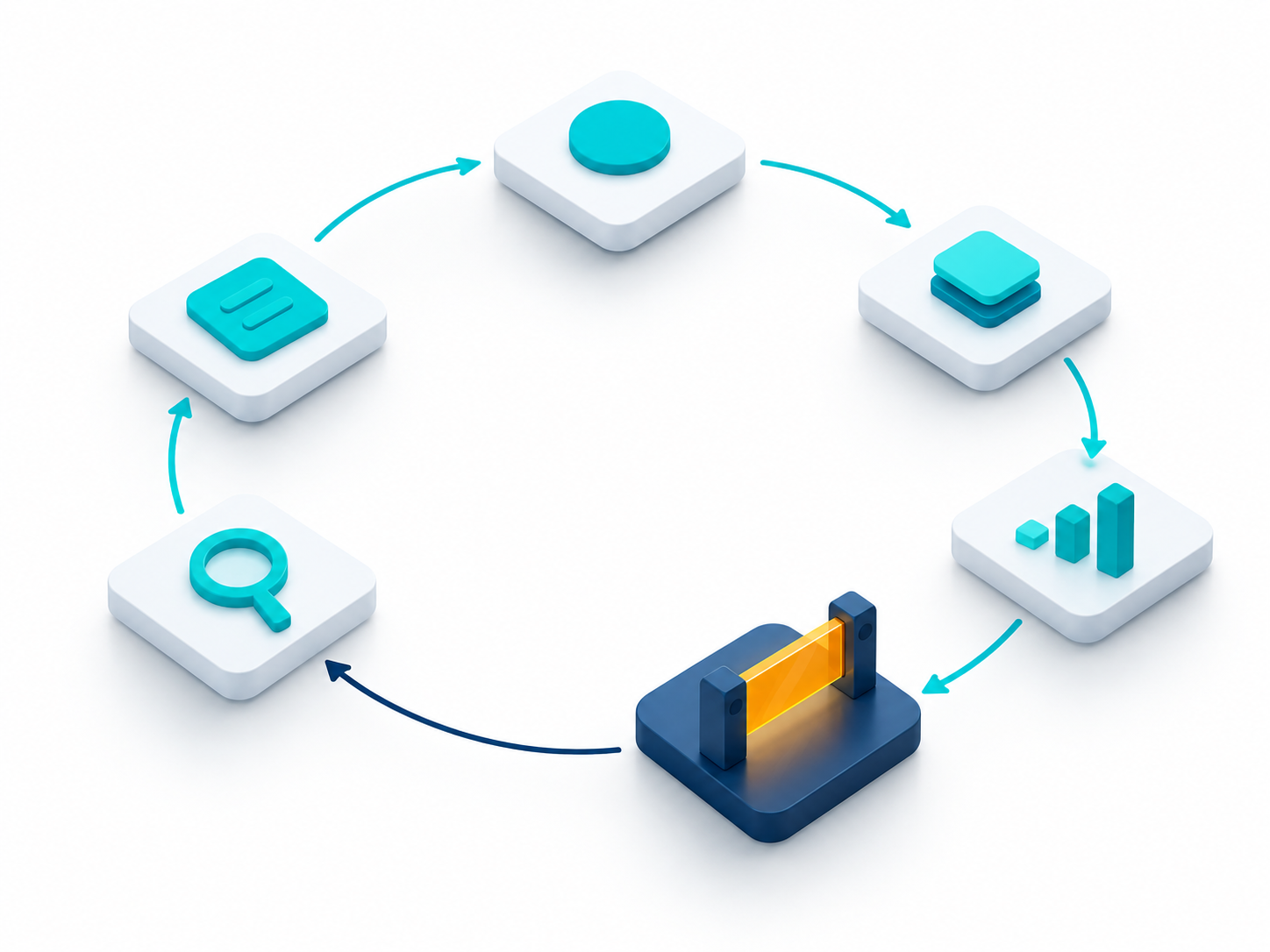
Testing an AI agent before production follows a fixed sequence, so the result is evidence a reviewer can accept rather than an opinion about a demo. Six steps cover it.
- Agree the acceptance criteria first. The business owner states the accuracy, escalation and cost thresholds the agent must meet, before any testing begins.
- Run in a sandbox with read only access. The agent works against real data but cannot change anything, so failures cost nothing.
- Measure against the test set. Score every dimension in the table above and record failures by type rather than as a single pass rate.
- Have a person review a sample. A specialist checks a share of cases, including ones the agent scored as correct, because trajectory errors hide behind right answers.
- Decide and record. The named owner approves, rejects or approves with narrower permissions and that decision is stored with the test results as evidence.
- Re-run after every change. Any change to the model, prompt, tools or rules triggers the same test set again, which is how regressions are caught.
A field service scheduling agent that passes on outcome accuracy but fails on cost per task should not go live on a technicality. The criteria agreed in step one are what decide it.
Evaluation as a Governance Gate
An evaluation gate is the control that prevents an agent from reaching production or from keeping its permissions, without current test evidence. It turns testing from a one time project activity into a standing requirement.
Three things make the gate real. Test results are stored with the agent version they belong to, permissions stay narrow until the agent passes at its intended scope and a failed re-test after a change blocks release instead of raising a warning.
This is the operational form of the measurement work described in an AI governance framework, applied per agent. It is also one of the seven criteria worth checking when you evaluate an enterprise AI platform, since a platform that cannot version test results leaves the evidence problem with your team.
Conclusion
AI agent evaluation decides whether an agent earns access to live systems. It measures outcomes, the path taken to reach them, policy compliance, escalation behavior and cost, against criteria the business agreed in advance.
Built from real cases and re-run on every change, the test set becomes the record that supports each release decision. Evaluation proves what an agent can do before launch and monitoring in production shows whether that holds, as one gate within the wider AI agent lifecycle management practice.
Frequently Asked Questions
What is AI agent evaluation?
AI agent evaluation is the measurement of an agent's behavior across complete business tasks, covering outcomes, tool use, policy compliance, escalation and cost. It differs from model testing because it judges the sequence of actions an agent takes, not just a single output.
How do you test an AI agent before production?
Agree the acceptance thresholds with the business owner, then run the agent in a sandbox with read only access against a test set built from real cases. Score every dimension, have a specialist review a sample and record the release decision with the results as evidence.
What metrics are used to evaluate AI agents?
The common metrics are task outcome accuracy, trajectory and tool use correctness, policy and permission compliance, escalation quality, and cost and latency per completed task. Escalation quality should measure both missed escalations and unnecessary ones.
How often should AI agents be re-evaluated?
Re-run the full test set after any change to the model, prompt, tools, data sources or business rules. Scheduled re-testing also catches drift when the underlying data or process changes without anyone altering the agent.