Human in the Loop AI: How Enterprises Design Approval and Escalation for AI Agents
Anil Nair is an enterprise AI strategist focused on AI governance, intelligent automation, agent orchestration and the architecture required to deploy AI systems safely across complex organizations.

Human in the loop AI is a design approach in which people approve, correct or stop AI decisions at points the business sets in advance. For enterprises deploying AI agents that update records and trigger transactions, it separates automation the organization can defend from automation it can only hope works.
The goal is not a person reviewing every step. The goal is a clear rule for which actions run on their own, which pause for approval and which route to a specialist, so people spend their time on decisions with real consequences.
What Is Human in the Loop AI?
Human in the loop AI is any AI system where a person takes part in the decision process by reviewing outputs, approving actions or providing corrections. The term started in machine learning, where people label training data and correct model predictions.
For AI agents, the meaning has shifted from training to execution. A person in the loop now decides whether an agent may carry out a specific action, such as changing a firewall rule, issuing a customer credit or closing a quality deviation record.
Human in the Loop vs Human on the Loop

Human in the loop and human on the loop describe two different levels of oversight: approval before an action versus monitoring with the power to intervene. A third model, human in command, keeps people in charge of the overall boundaries of an AI system and the right mix depends on risk, autonomy and domain.
| Oversight model | Role of the person | Best suited for |
|---|---|---|
| Human in the loop | Approves or rejects each action before it runs | Irreversible, regulated or high value actions |
| Human on the loop | Monitors activity and intervenes when needed | High volume, reversible work with clear limits |
| Human in command | Sets scope, limits and stop conditions for the whole system | Every AI deployment, as the top layer of control |
Most enterprises combine all three. An IT operations agent can reset user passwords under human on the loop monitoring, while every change to a production firewall waits for an engineer to approve it.
When AI Agents Need a Human in the Loop
An AI agent needs a human in the loop when the cost of a wrong action is higher than the value of acting instantly. Three conditions cover most cases.
Irreversible or High Impact Actions
Irreversible actions are those that cannot be cleanly undone, such as sending external communications, moving money or deleting data. The OWASP AI Agent Security Cheat Sheet recommends explicit human approval for high impact or irreversible actions, with each approval tied to the exact action, target and parameters being approved.
Low Confidence Decisions
A low confidence decision is one where the agent's certainty falls below a threshold set for that action type. A utility's outage dispatch agent might assign crews automatically when fault data is clear, yet route the case to a supervisor when sensor readings conflict.
Thresholds should differ by action. A confidence level acceptable for tagging a support ticket is far too low for approving a warranty exception.
Actions Outside Policy
An out of policy action is any request that the agent's rules do not clearly permit, including first time situations the agent has never handled. These should always escalate rather than leave the agent to improvise, because improvisation is where silent errors begin.
How to Design Escalation That Works

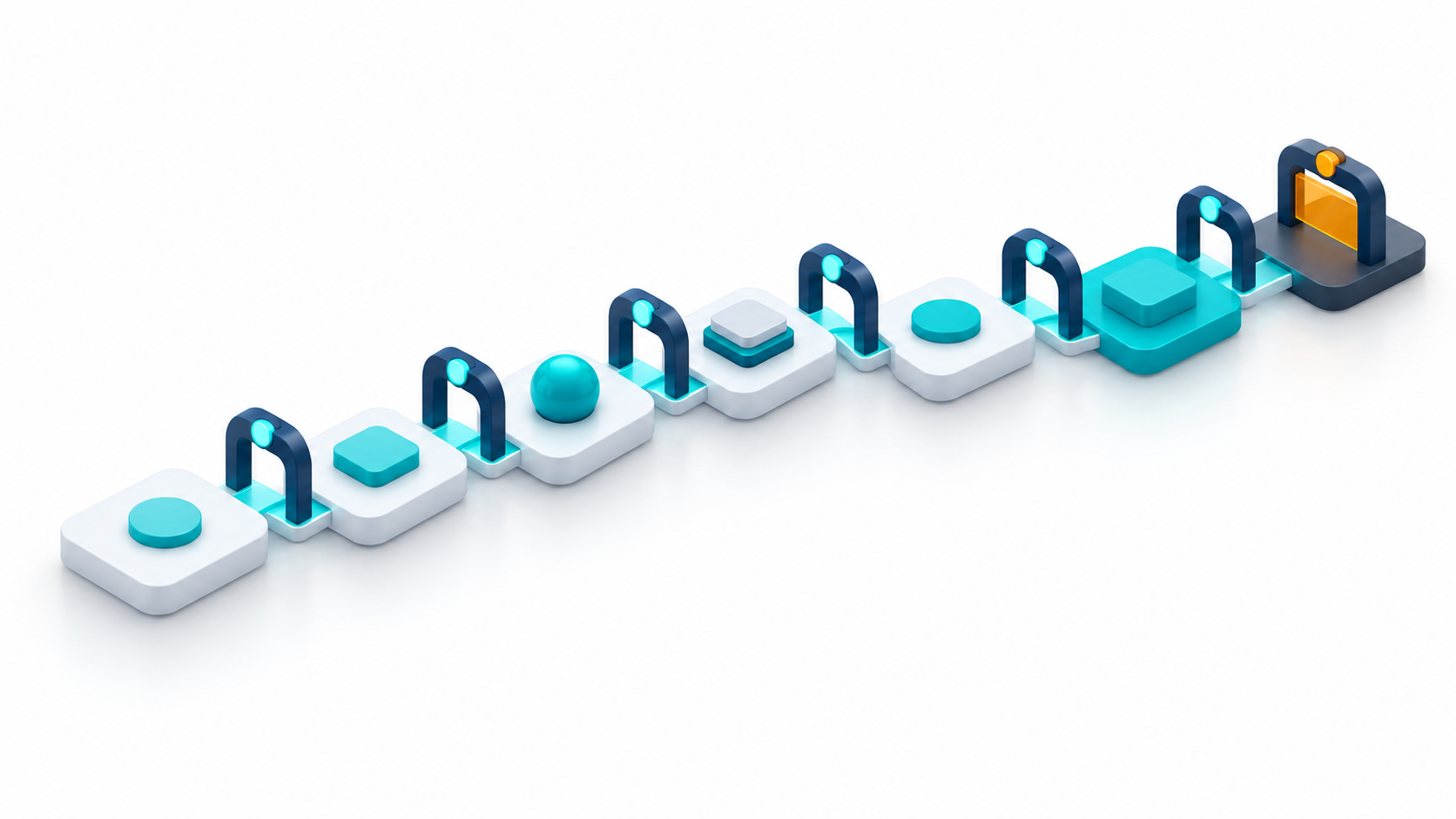
Escalation design is the set of rules that decides where a paused action goes, what the approver sees and what happens if nobody responds. Six steps give a working design.
- Classify every action by risk. List what each agent can do and mark each action as automatic, monitored or approval required.
- Set confidence thresholds per action type. Define the level below which the agent must escalate, and record why that level was chosen.
- Route to the right approver. Send each escalation to the person with authority over that decision, not to a shared queue that nobody owns.
- Package the context. Show the approver what the agent saw, what it proposes and why, so the review takes seconds instead of a fresh investigation.
- Decide the timeout rule. Practitioner guidance recommends denying the action by default when an approval times out, so a paused agent never proceeds on its own.
- Capture every decision as feedback. Record each approval, rejection, correction and override with a short reason code, because this record is what the agent learns from.
Ownership of each agent and its approvers is covered in our guide to AI agent ownership, policies and lifecycle.
How Human Feedback Improves Agent Accuracy
Human feedback is the record of what approvers accepted, rejected or corrected, captured in a form the system can learn from. It is the main way an agent improves inside a specific business, because the underlying model was trained on public data and knows nothing about the organization's policies, exceptions or customers.
A usable record holds the proposed action, the agent's confidence score, the approver's decision, any correction and a reason code from a fixed list, such as missing document or policy exception. That feedback goes to four places: it corrects rules that were missing or wrong, it becomes reference examples the agent retrieves before deciding, it builds evaluation sets so past mistakes are tested on every change, and it calibrates confidence scores against what approvers actually decided.
Fine tuning the model is a further option where volume justifies it. Most of the gain comes from the first four, and none of them are possible unless approvals were captured with their reasons.
Human Oversight Requirements Under the EU AI Act
The EU AI Act makes human oversight a legal requirement for high risk AI systems under Article 14. Such systems must be designed so that people can effectively oversee them while they are in use, with oversight measures proportionate to the system's risk, autonomy and context of use.
The Act also names automation bias, the tendency to rely too heavily on AI output, as a risk that oversight must address. Legal guidance on Article 14 notes that it does not require manual approval of every output, only oversight that is real and able to intervene.
Approval fatigue is the everyday form of this risk. When approvers see hundreds of routine requests, they start approving without reading, which is why gates belong only on decisions that matter.
How Agent Autonomy Grows Over Time
Earned autonomy is the practice of expanding an agent's authority only as its track record proves it reliable for a specific task. It lets enterprises start with tight approval gates and relax them based on evidence.
In the AIQoD platform, each agent carries a Dynamic Twin that holds its identity, permissions, decision history and current confidence. Authority is earned per agent and per task as that record builds. An agent that has handled telecom billing credits accurately for months may move from approval to monitoring for small amounts, while larger credits still wait for a person.
| Agent confidence | Oversight mode | What the person does |
|---|---|---|
| Low | Human in the loop | Reviews and decides before the action runs |
| Medium | Human in the loop, with sampling once accuracy is proven | Approves exceptions and spot checks a share of cases |
| High, with a proven record | Monitored autonomy | Watches trends and steps in on drift or incidents |
Two conditions keep this safe. Confidence must be calibrated against real approver decisions rather than reported by the model alone, and irreversible or regulated actions keep their approval gate whatever the confidence score.
This works alongside separate read and write permissions, covered in our guide to read and write security for AI agents and sits inside a wider AI governance framework.
Conclusion
Human in the loop AI works when oversight is placed deliberately rather than everywhere. Irreversible actions, low confidence decisions and anything outside policy go to a person, while routine work runs under monitoring.
Clear escalation routes, a deny by default timeout and a complete decision log turn oversight from a policy statement into a working control. Captured with their reasons, those decisions also correct rules, build test cases and calibrate confidence, which is what lets autonomy widen task by task. As track records build, autonomy can expand one task at a time, with people keeping authority over the decisions that matter most.
Frequently Asked Questions
What is an example of humans in the loop AI?
An IT operations agent that drafts a production firewall change and waits for an engineer's approval is a human in the loop system. Routine actions like password resets can run automatically, while the risky change pauses for a person.
Does human in the loop mean a person approves every AI decision?
No, well designed human in the loop systems reserve approval for high impact, low confidence or out of policy actions. Routine, reversible work runs automatically under monitoring, which keeps approvers focused and prevents approval fatigue.
Who should approve actions in a human in the loop workflow?
The approver should be the person who already holds authority for that decision in the business, such as a finance manager for payments or an engineer for infrastructure changes. Routing escalations to named owners rather than shared queues keeps response times short and accountability clear.
How do AI agents learn from human in the loop feedback?
Approvals, rejections and corrections are captured with a reason code, then used to fix rules, add reference examples, build evaluation sets and calibrate confidence scores. Without that record the agent repeats the same errors, because its underlying model holds no knowledge of the organization's policies.