AI Agent Orchestration: How Enterprises Coordinate Multi Agent Workflows
Anil Nair is an enterprise AI strategist focused on AI governance, intelligent automation, agent orchestration, and the architecture required to deploy AI systems safely across complex organizations.

AI Agent Orchestration coordinates specialized AI agents across enterprise workflows by managing task routing, delegation, communication, context transfer and workflow state. An effective orchestration framework ensures that the right agent handles each task, exceptions reach the appropriate human and complex business processes remain observable and accountable.
What Is AI Agent Orchestration?
AI Agent Orchestration is the coordination layer that determines how multiple AI agents work together to complete a business process. It manages task distribution, agent selection, communication, workflow state and the movement of work from one stage to another.
A single AI agent may perform a specific task, such as extracting invoice data or screening a resume. Enterprise workflows, however, often require multiple capabilities working in a defined sequence.
For example, an invoice processing workflow may require one agent to extract information, another to validate vendor details, a third to identify duplicates and a human reviewer to handle exceptions. Orchestration connects these responsibilities into a coordinated process.
Why Enterprises Need AI Agent Orchestration
Enterprise workflows frequently span several applications, departments and decision points. Without an orchestration layer, individual agents may operate independently, duplicate work, lose context or fail to communicate important exceptions.
AI Agent Orchestration provides a structured way to coordinate specialized agents while maintaining visibility into the overall workflow.
The main enterprise challenges include:
- Selecting the appropriate agent for each task
- Dividing complex work into manageable activities
- Maintaining context between workflow stages
- Managing dependencies between agents
- Handling failures and exceptions
- Tracking workflow progress and outcomes
Orchestration does not mean that every task must involve multiple agents. Simple tasks may be completed by one agent, while more complex processes benefit from coordinated specialization.
Agent Selection and Intelligent Task Routing
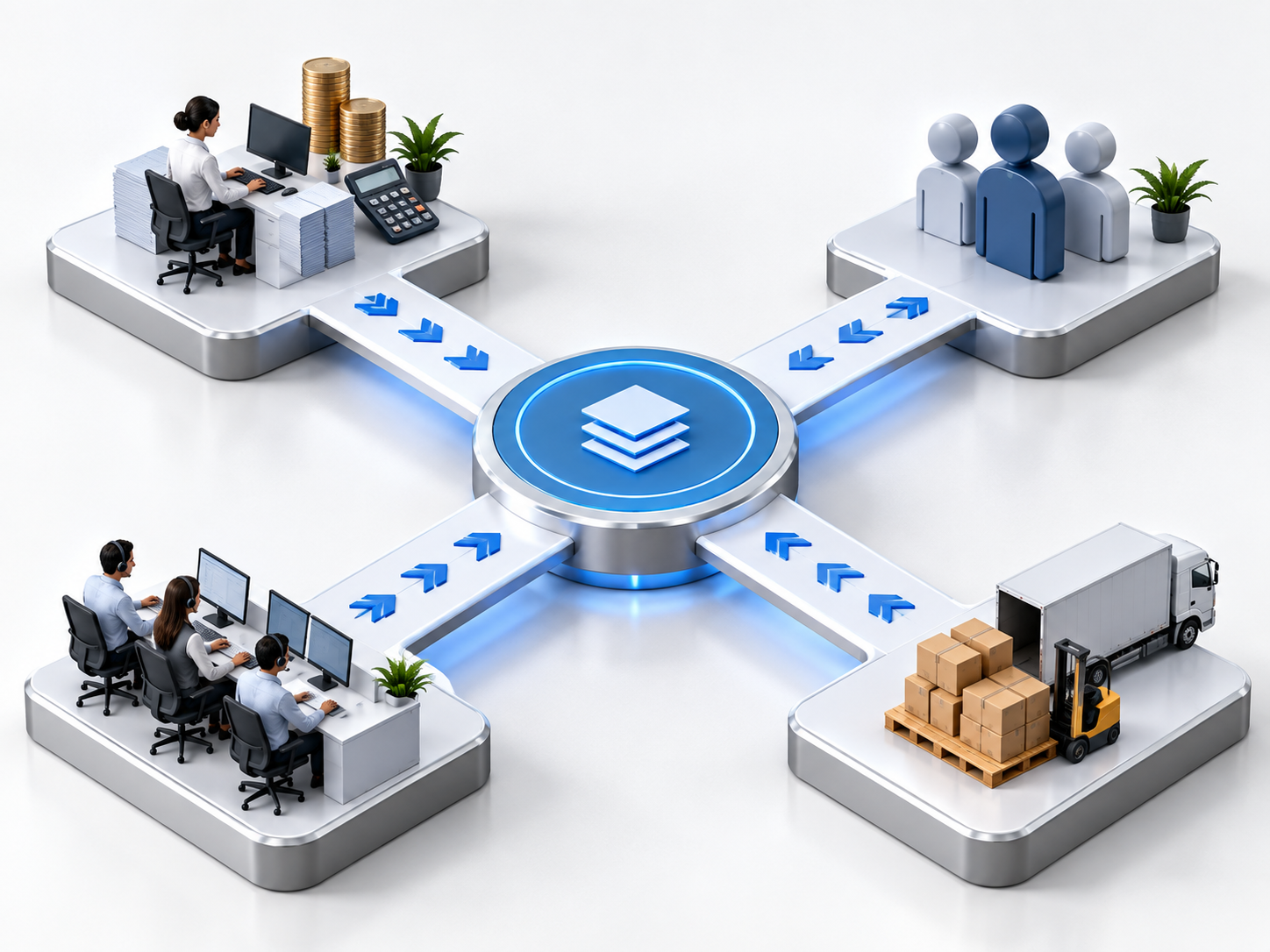
Agent selection determines which AI agent should handle a particular task based on its capabilities, context, availability and assigned responsibility. Intelligent routing connects an incoming request with the agent or workflow stage that can process it appropriately.
A routing layer may evaluate the type of request, required business capability, available context and current workflow state before selecting an agent.
For example, a finance workflow may route an invoice to different agents depending on whether the task involves data extraction, duplicate detection, vendor validation or exception review.
An effective routing model should consider:
- Task type and business objective
- Agent capabilities
- Required information and context
- Workflow stage
- Service level requirements
- Escalation conditions
Routing rules should remain understandable and reviewable. When a workflow is routed incorrectly, the organization should be able to identify why the decision was made and where the process diverged.
Task Decomposition and Agent Delegation
Task decomposition breaks a complex business objective into smaller activities that can be completed by specialized agents. Delegation then assigns those activities to the appropriate agents based on their responsibilities.
For example, a recruitment workflow may begin with a hiring request and divide the work into job description analysis, candidate screening, ranking, interview scheduling and reporting.
Each activity should have a defined input, expected output and completion condition. This helps the orchestration layer determine whether the next activity can begin.
A practical decomposition process includes:
- Identify the overall business objective.
- Divide the objective into connected tasks.
- Identify dependencies between tasks.
- Assign each task to a suitable agent.
- Define the expected output from each stage.
- Establish conditions for completion or escalation.
Decomposition should not create unnecessary complexity. If a task can be completed reliably by one agent, introducing additional agents may increase coordination overhead without improving the outcome.
Workflow patterns help determine how tasks should be distributed and executed across multiple agents. Google's Agent Development Kit documents patterns such as sequential execution, parallel execution and hierarchical coordination, which provide useful architectural models for structuring multi agent workflows.
Context Transfer Between AI Agents
Context transfer allows one agent to pass relevant information to another agent as a workflow progresses. Without effective context management, agents may repeat earlier work, make decisions using incomplete information or misunderstand the current stage of a process.
Context should include the information required for the next task rather than an uncontrolled collection of all previous interactions.
For example, an invoice validation agent may pass extracted invoice details, vendor information, validation results and identified discrepancies to an exception handling agent.
A structured context transfer model should define:
- Information received by the next agent
- Source of the information
- Current workflow status
- Completed activities
- Outstanding issues
- Expected next action
Context should be accurate, relevant, and traceable. The orchestration layer should also account for situations where required information is missing or conflicting.
The enterprise intelligence layer can provide shared business context, while orchestration determines which context is required at each workflow stage. These are related capabilities, but they serve different purposes.
Workflow State and Process Coordination
Workflow state represents the current position of a business process, including completed tasks, pending activities, failed operations, and required approvals. Orchestration uses this state to determine what should happen next.
A workflow without reliable state management may lose track of completed activities or restart tasks unnecessarily. This can lead to duplicate processing, inconsistent outcomes, and difficult investigations.
A workflow state model may include:
| State | Meaning |
|---|---|
| Initiated | The workflow has received a valid request |
| In progress | One or more tasks are being processed |
| Waiting | The workflow requires information or approval |
| Completed | All required tasks have finished |
| Failed | A task could not be completed |
| Escalated | Human review is required |
| Cancelled | The workflow has been stopped |
State transitions should be defined for each major workflow stage. The orchestration layer should know whether a task can be retried, redirected, paused or escalated.
Communication Between AI Agents
Agent communication enables specialized agents to exchange task inputs, outputs, status updates, and exception details. Effective communication reduces duplication and helps each agent understand its role within the larger workflow.
Communication should be structured around business requirements rather than unrestricted conversation between agents.
For example, a customer service agent may request order information from an order inquiry agent. The response should include the relevant order status and supporting details required to continue the customer service workflow.
A coordinated communication model should define:
- The purpose of the request
- The sending and receiving agents
- The required information
- The expected response format
- Timeout and failure conditions
- Escalation requirements
Agent communication also needs clear responsibility boundaries. The orchestration layer coordinates the workflow, while governance and security frameworks establish ownership, authorization, and permitted actions.
Detailed access permissions and read and write controls belong to the enterprise read and write security architecture.
Multi agent collaboration requires clear communication structures and defined responsibilities between participating agents. Microsoft's AutoGen AgentChat documentation describes agent interaction and team based collaboration patterns that can help inform the design of coordinated agent workflows.
Conflict Resolution and Failure Handling
Enterprise workflows can encounter incomplete information, conflicting outputs, unavailable systems and unsuccessful agent executions. An orchestration framework must define how these conditions are identified and handled.
Not every failure should trigger an immediate restart. Repeating the same task without understanding the failure may increase processing costs or create duplicate actions.
A failure handling model should distinguish between:
- Temporary system failures
- Missing or invalid information
- Conflicting agent outputs
- Unsupported requests
- Workflow timeouts
- High impact exceptions
Depending on the situation, the workflow may retry a task, route it to another agent, request additional information, pause for human review or terminate safely.
For example, if two validation agents produce conflicting results, the orchestration layer should not silently select one result. It should apply a defined resolution process or escalate the discrepancy to an appropriate reviewer.
Human Escalation in AI Agent Workflows
Human escalation allows an enterprise workflow to pause when an agent encounters uncertainty, an exception or a decision that requires human judgment. Escalation should be designed into the workflow rather than added only after an agent fails.
The orchestration layer can identify conditions that require human involvement, such as conflicting outputs, missing information, policy exceptions or high impact business decisions.
A clear escalation process should specify:
- The conditions that trigger escalation
- The responsible reviewer
- The information presented to the reviewer
- The expected response
- The actions available after review
- The record of the final decision
Human oversight is closely connected to governance, but the focus of orchestration is the movement of work and the coordination of the escalation process. Governance defines who is accountable and which decisions require approval.
Orchestration Observability and Workflow Performance
Orchestration observability provides visibility into how a workflow progresses across agents, systems and decision points. It helps organizations identify delays, failed tasks, repeated processing and workflow bottlenecks.
Technical performance metrics alone are not sufficient. Enterprises should also examine whether the workflow is completing its intended business objective.
Useful orchestration metrics include:
- Workflow completion rate
- Average processing time
- Agent response time
- Number of retries
- Escalation frequency
- Failure rate by workflow stage
- Tasks completed per agent
- Percentage of workflows requiring manual intervention
These measurements help teams identify where a workflow needs better routing, clearer task definitions, additional context or revised escalation conditions.
Monitoring should provide sufficient operational evidence without requiring unrestricted access to private internal reasoning. The goal is to understand workflow behavior, decisions, outcomes and failure points.
Designing AI Agent Orchestration for Enterprise Operations
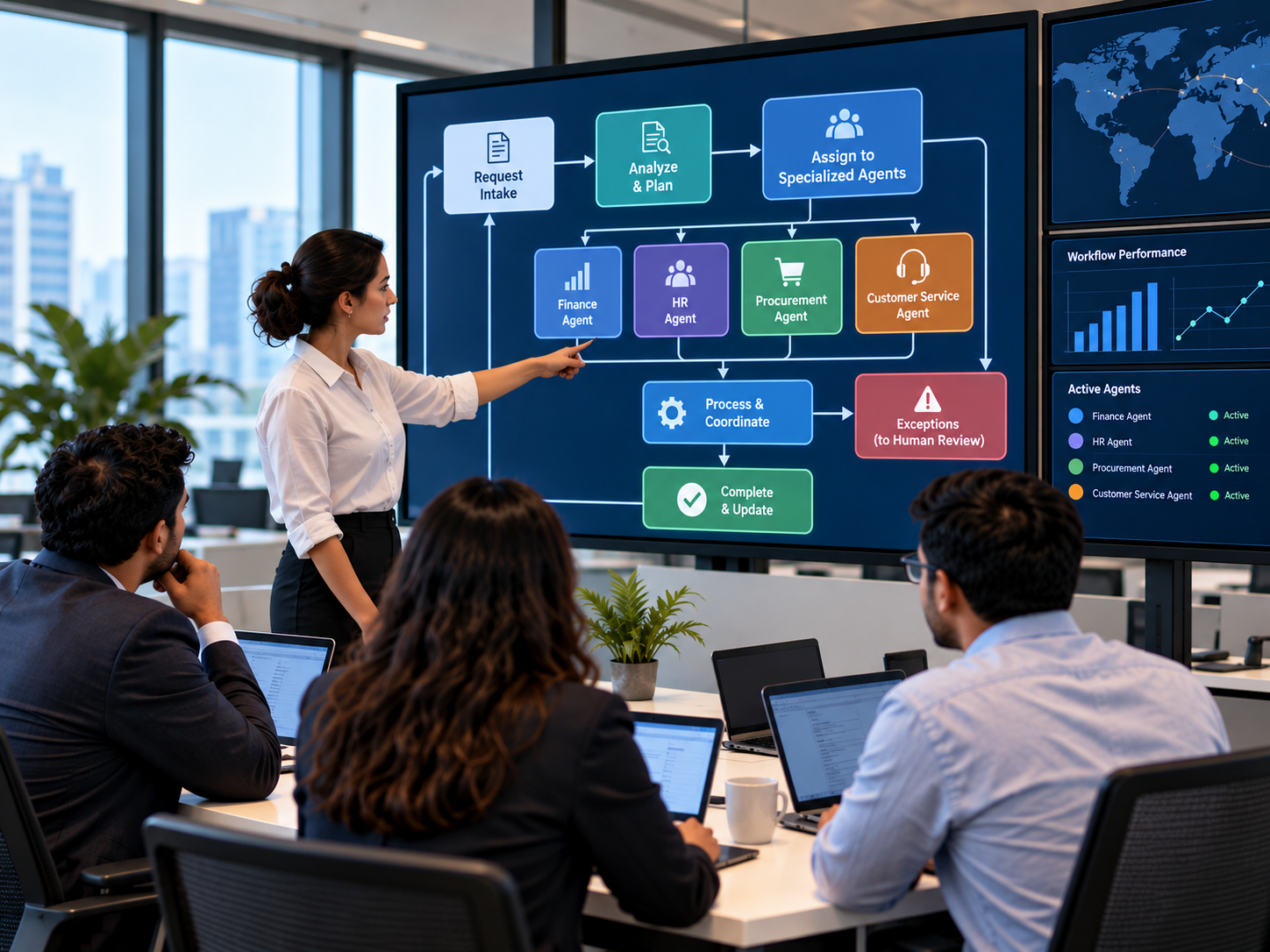
Enterprise orchestration should be designed around business processes rather than isolated agent capabilities. The architecture must connect workflow objectives, specialized responsibilities, context, state and exception handling.
A practical orchestration design includes the following components:
- Workflow entry point: Receives an event, request, schedule or approved business trigger.
- Task analysis: Determines the objective, required information and activities needed to complete the workflow.
- Agent selection: Routes each task to an agent with the appropriate capability and responsibility.
- Context and state management: Maintains the information and workflow status required for each stage.
- Execution coordination: Tracks task completion, dependencies, responses and transitions between agents.
- Exception and escalation management: Directs failures, uncertainty and approval requirements to the appropriate handling process.
- Workflow observability: Records operational events and measures the performance and outcome of the complete workflow.
This structure separates the coordination of work from the governance of responsibility and the technical enforcement of system access.
How to Implement AI Agent Orchestration
AI Agent Orchestration should be introduced through a defined business workflow with measurable outcomes. Enterprises should avoid starting with a large network of agents before understanding the process being coordinated.
Step 1: Select a Defined Business Workflow
Choose a process with a clear beginning, expected outcome, and identifiable workflow stages. Examples include invoice processing, recruitment coordination, customer service resolution or vendor onboarding.
Step 2: Map the Workflow
Document the sequence of tasks, dependencies, decision points, required information and exception conditions. This provides the foundation for orchestration design.
Step 3: Define Agent Responsibilities
Assign each task to an agent based on its capabilities and business responsibility. Avoid assigning overlapping responsibilities that may create duplicated or conflicting work.
Step 4: Design Context and State Management
Define what information each agent receives, what it produces and how the workflow records progress. Ensure that incomplete or conflicting information can be identified.
Step 5: Establish Routing and Escalation Rules
Define how tasks are routed, when workflows can retry, and when human review is required. These rules should be clear enough to support testing and operational review.
Step 6: Test Failure Scenarios
Test unavailable systems, missing data, conflicting outputs, timeouts and incomplete agent responses. Confirm that the workflow can pause or escalate safely.
Step 7: Measure Workflow Outcomes
Track completion time, failure frequency, escalation rates and business results. Use these measurements to improve routing, task allocation and workflow design.
Common AI Agent Orchestration Mistakes
- Creating Too Many Agents: Introducing an agent for every small activity can increase coordination complexity. Use specialized agents when their separation provides a clear business or operational benefit.
- Using Unclear Task Boundaries: When two agents have overlapping responsibilities, they may duplicate work or produce conflicting outputs. Each agent should have a defined role and expected result.
- Passing Incomplete Context: An agent may produce an incorrect result when it does not receive the information needed for its task. Context requirements should be defined for every important workflow transition.
- Ignoring Workflow State: Without reliable state management, workflows may lose track of completed tasks or repeat activities. Each stage should have clear status and transition conditions.
- Treating Failures as Simple Retries: Repeating a failed task without identifying the underlying issue can increase delays and create duplicate processing. Failure handling should distinguish between temporary errors, invalid information and exceptions requiring human review.
- Measuring Only Agent Performance: A workflow may contain individually effective agents and still deliver poor business results. Orchestration performance should be measured at the complete process level.
AI Agent Orchestration Within the Enterprise Intelligence Layer
An Enterprise Intelligence Layer provides the broader environment in which enterprise agents can access relevant business context, connect with systems and support operational workflows. AI Agent Orchestration coordinates how those agents work together to complete specific processes.
At AIQoD, the enterprise intelligence approach connects agentic capabilities with workflow coordination across business systems. The orchestration layer helps structure task routing, agent collaboration, context transfer and operational outcomes within a governed enterprise environment.
The responsibilities remain distinct:
- The intelligence layer provides a broader enterprise context.
- Orchestration coordinates agents and workflow stages.
- Governance defines ownership, policies, and accountability.
- Read and write security controls technical access and action boundaries.
This separation helps enterprises design agentic systems that are easier to understand, test, operate and improve.
Conclusion
AI Agent Orchestration enables enterprises to coordinate specialized agents across complex business workflows. Its core responsibilities include intelligent routing, task decomposition, context transfer, workflow state management, agent communication, failure handling and operational observability.
Successful orchestration depends on clearly defined agent responsibilities and measurable workflow outcomes. Enterprises should begin with a specific process, design the coordination model, test exception scenarios and improve performance using operational evidence.
AIQoD approaches agentic AI through an enterprise intelligence environment that connects agents, workflows and business systems. When orchestration is designed alongside governance and security, organizations can build coordinated workflows with clear operational accountability and human oversight.
Frequently Asked Questions
What is AI Agent Orchestration?
AI Agent Orchestration is the coordination of AI agents, tasks, context, and workflow stages within a business process. It determines how work is routed, delegated, monitored and completed across agents.
What is the difference between an AI agent and AI Agent Orchestration?
An AI agent performs a defined task or responsibility, while orchestration coordinates multiple tasks and agents within a larger workflow. Orchestration manages routing, dependencies, state, communication and exceptions.
Why is context transfer important in multi agent workflows?
Context transfer ensures that each agent receives the relevant information required for its task. Structured context reduces repeated work, incomplete decisions and misunderstandings between workflow stages.
How does AI Agent Orchestration handle failures?
Orchestration identifies failures and applies predefined responses such as retrying, redirecting, pausing, or escalating a task. The appropriate response depends on the failure type, workflow state and business impact.